

When Accomplishment Is Matched by Humanity
When Accomplishment Is Matched by Humanity
Some people impress you because of what they have achieved. The truly memorable ones impress you because of how they treat people.
I have met a remarkable range of individuals during my life. They have included an East End housewife who survived Nazi bombing and wartime hunger, immigrants who escaped the Taliban or Iraqi militias, Her Majesty Queen Elizabeth II and other members of the Royal Family. During my legal career, I represented well known figures from film and entertainment.

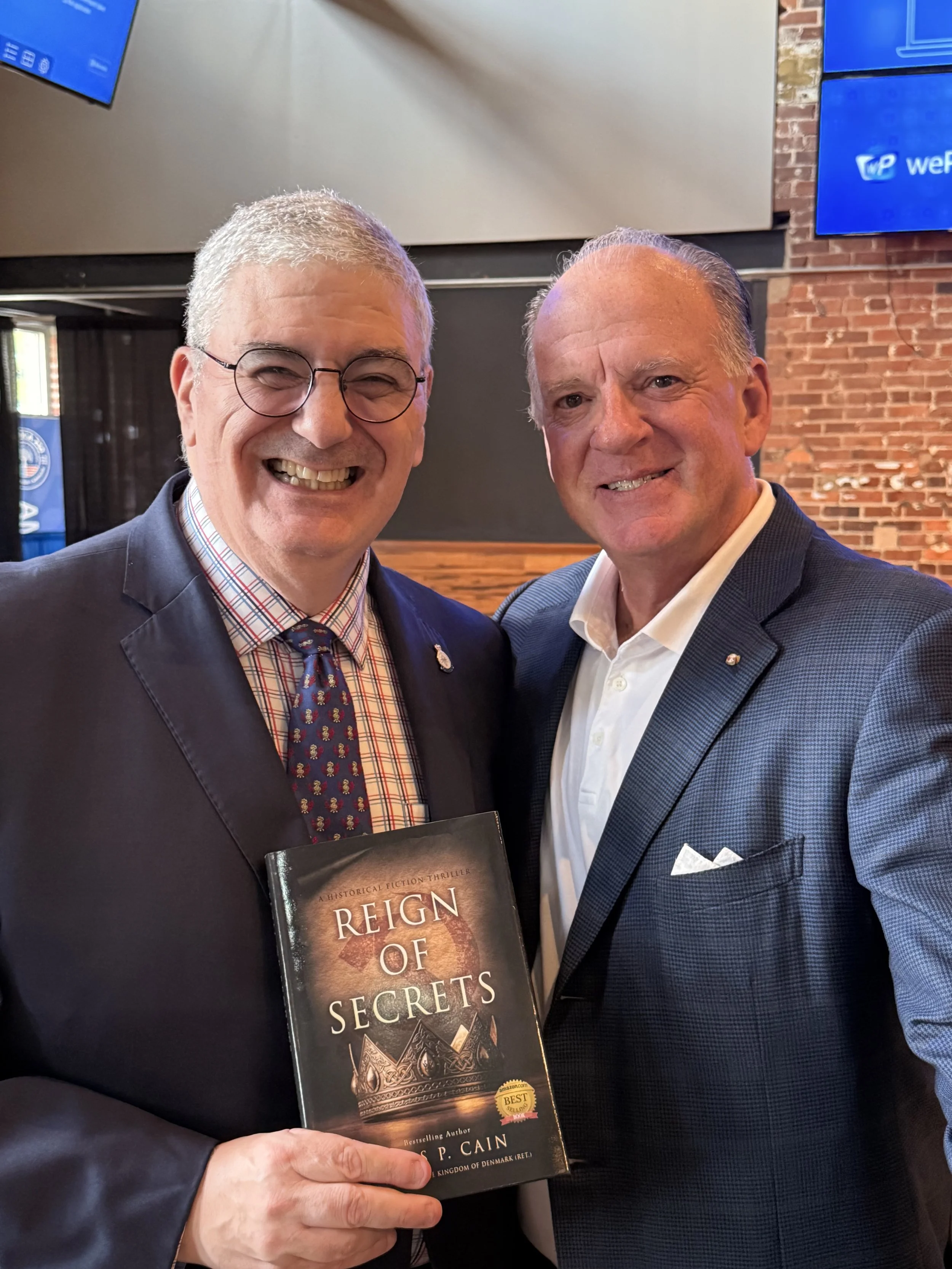
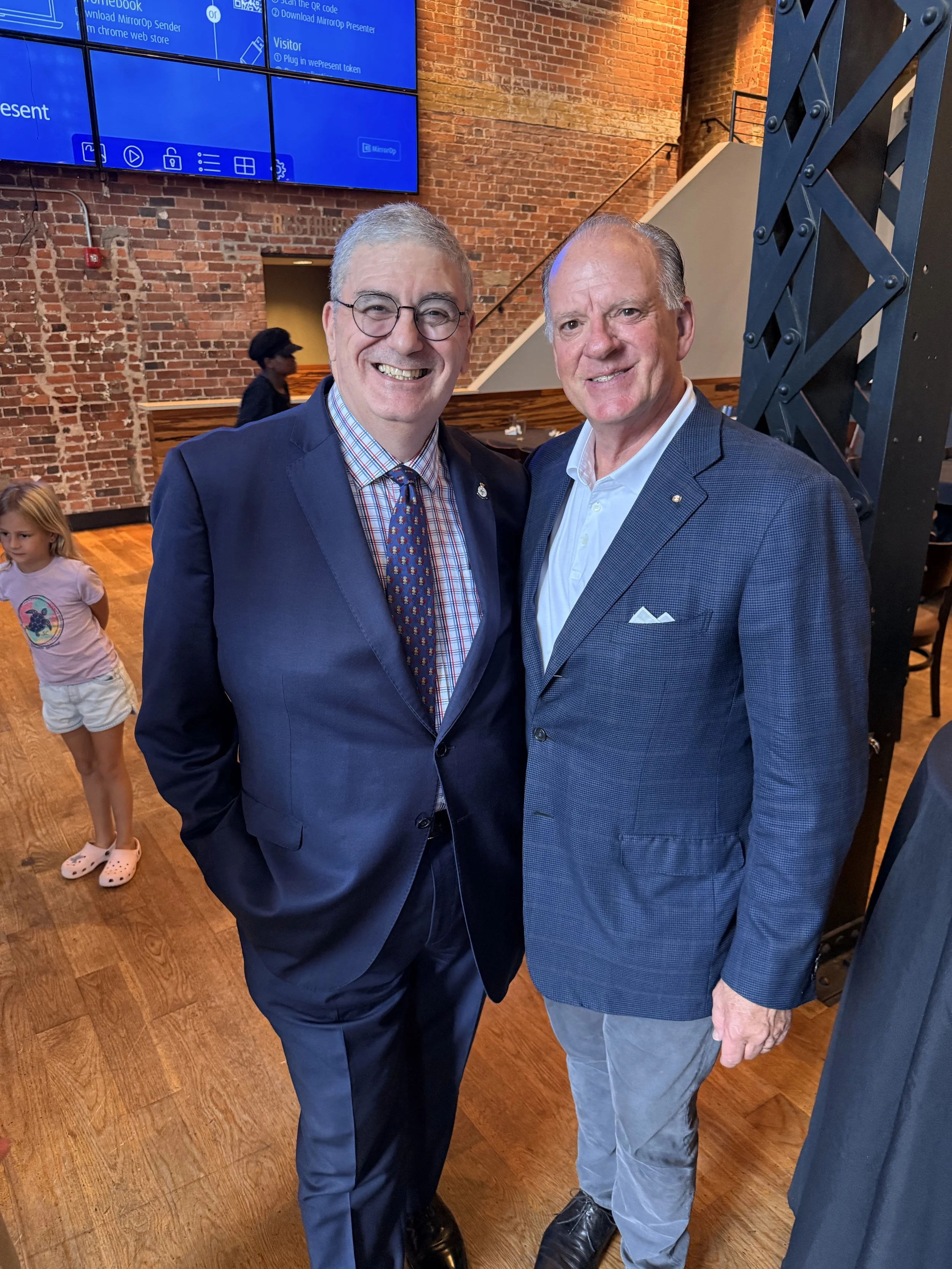
Some people impress you because of what they have achieved. The truly memorable ones impress you because of how they treat people.
I have met a remarkable range of individuals during my life. They have included an East End housewife who survived Nazi bombing and wartime hunger, immigrants who escaped the Taliban or Iraqi militias, Her Majesty Queen Elizabeth II and other members of the Royal Family. During my legal career, I represented well-known figures from film and entertainment.
Consequently, I am not often starstruck or impressed by fame, titles, or public prominence. Meeting Ambassador James P. Cain, however, was a treat.
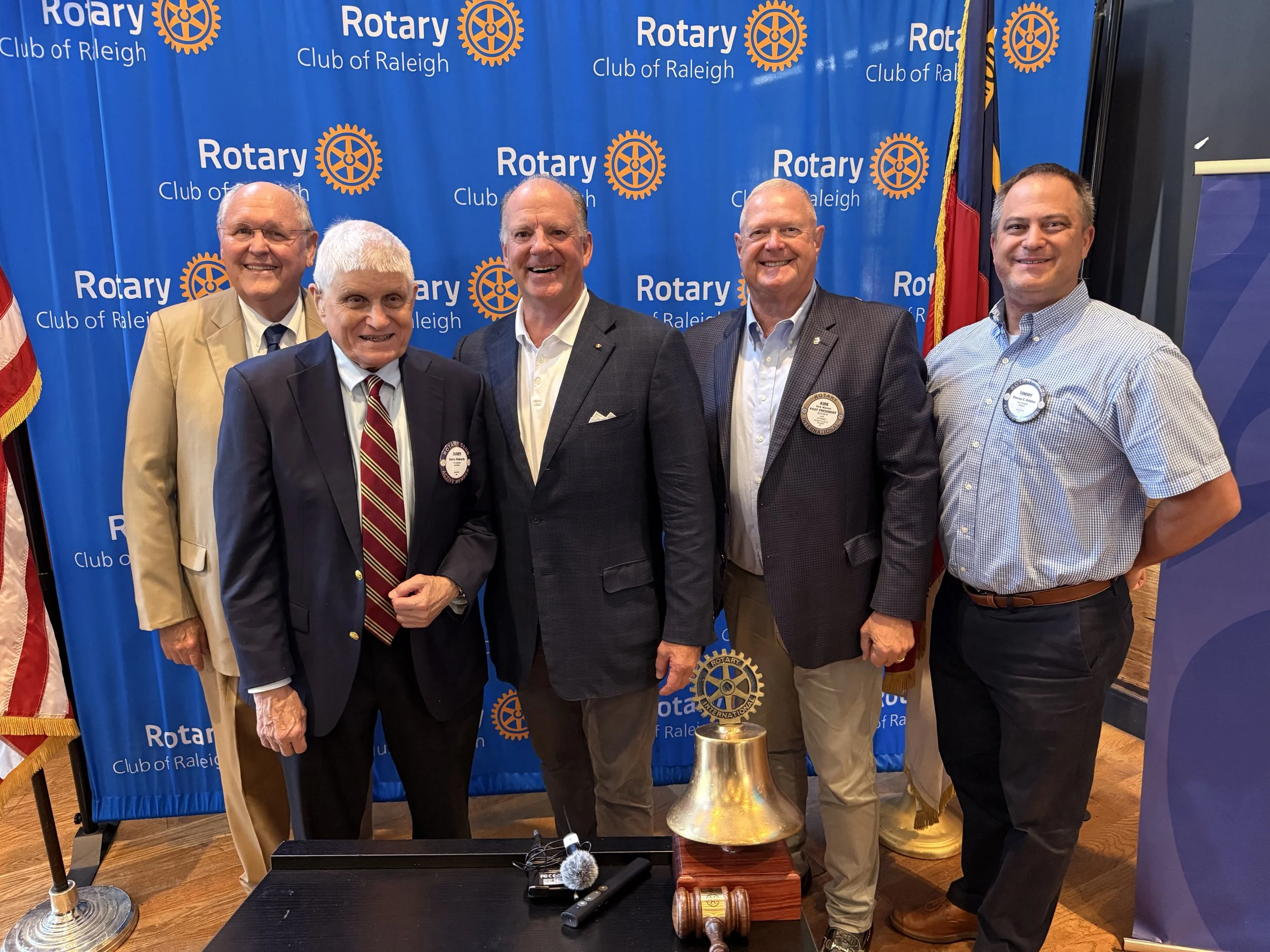
An Afternoon at the Rotary Club of Raleigh
Ambassador Cain, the former United States Ambassador to the Kingdom of Denmark and author of Reign of Secrets, joined us to speak at the Rotary Club of Raleigh.
I had been impressed by him before we met. After listening to him speak and spending time in conversation with him, I am even more so.
He is exceptionally intelligent and insightful, but what struck me most was his kindness, warmth and humanity. He was a pleasure to deal with before and during the meeting.
It is refreshing to meet someone who combines genuine accomplishment with professionalism, humility and an obvious interest in other people.
The Leadership Lesson
This offers an important lesson for anyone entrusted with leadership.
Expertise can establish credibility. A title can confer authority. Accomplishment may attract attention. Character, however, determines the impression we leave behind.
The strongest leaders do not need to dominate every conversation or continually remind others of their status. They remain curious. They listen. They treat others with courtesy and respect, irrespective of rank or position.
That combination of authority and humanity builds trust. People remember it long after a professional encounter has ended.
Ambassador Cain demonstrated precisely those qualities.
Reign of Secrets
Ambassador Cain’s historical fiction thriller, Reign of Secrets, draws upon a life shaped by law, business, public service, and diplomacy.
If you enjoy stories involving history, power, international affairs and the secrets that influence events, I encourage you to consider reading it. I am already looking forward to the next chapter.
I am also looking forward to meeting Ambassador Cain again. He is one of those rare people whom I suspect I could listen to all day without becoming bored.
Thank you, Ambassador, for joining the Rotary Club of Raleigh and for such an enjoyable and thought-provoking afternoon.
Leadership grounded in character is central to my work with lawyers, executives, and business owners through Peter Gourri Coaching & Consulting LLC. Learn more at www.petergourri.com.
To discuss leadership, executive coaching or business consulting, arrange a conversation with me at:
https://calendly.com/petergourri-coaching/success
If this article brought someone to mind, please consider sharing it with them.
Transparency statement: I have used AI as a drafting and editing tool to help formulate and prepare this article. The experiences, opinions, thoughts, and ideas are mine, and I take full responsibility for the final words and everything published under my name.
When Strength Becomes a Business Blind Spot
Peter Gourri explores how veterans can retain integrity, loyalty, and resilience while using stronger commercial safeguards in business.
Veterans can be exceptional in business. We can also be remarkably easy to take advantage of.
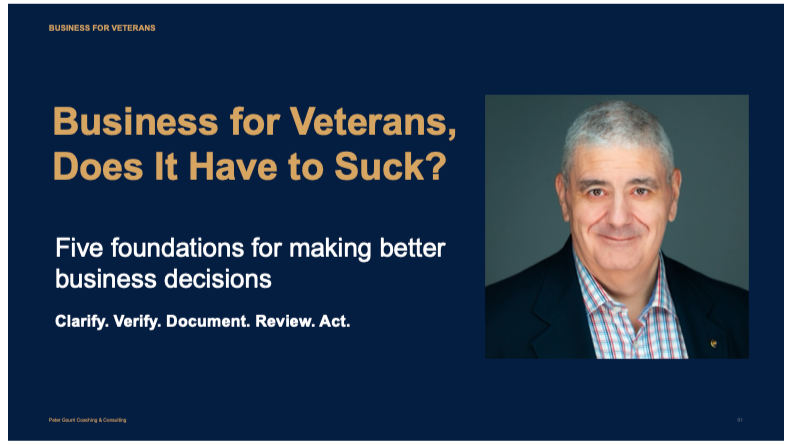
Last Thursday, I spoke to V.E.T. Connect, Veteran Entrepreneurs of the Triangle, about a deliberately provocative question: “Business for Veterans, Does It Have to Suck?”
Veterans can be exceptional in business. We can also be remarkably easy to take advantage of.
Last Thursday, I spoke to V.E.T. Connect, Veteran Entrepreneurs of the Triangle, about a deliberately provocative question: “Business for Veterans, Does It Have to Suck?”
Veterans often bring integrity, loyalty, accountability, diligence, and resilience into civilian business. The danger arises when we assume everyone else operates to the same standards.
Trust is a value, not a control
Trust matters, but trust without verification is not a commercial strategy. Before an important commitment, check experience, references, responsibilities, and financial assumptions. This is not treating everyone as dishonest. It is respecting the decision.
Clarity prevents avoidable conflict
Commercial relationships can look structured while remaining remarkably ambiguous. Words such as “partner”, “team” and “success” may mean different things to different people. Ask what is promised, who is responsible, and how success will be judged.
If a conversation matters, confirm it in writing. A courteous email can prevent months of disagreement.
Resilience needs judgment
Veterans are taught to persevere, but perseverance without judgment can become self-inflicted damage.
Review important relationships and projects. Look at the evidence rather than the effort already invested. Ask whether the original objective still makes sense.
Five practical safeguards
The framework I shared is intentionally simple:
Clarify. Define the objective, responsibilities, conditions of satisfaction, payment, and decision-making authority.
Verify. Check the people, evidence, assumptions, and dependencies.
Document. Record commitments, changes, decisions, ownership and exit arrangements.
Review. Revisit the evidence and ask whether continuing still makes sense.
Act. Continue, adapt, pause or stop. Do not leave a known problem untouched because confronting it feels uncomfortable.
The answer is not cynicism or abandoning the values learned through service. It is combining them with commercial awareness, boundaries and the confidence to make difficult decisions.
What personal or professional strength have you had to use differently in business?
I am available for speaking engagements, workshops and panel discussions, both in person and online, for businesses, professional associations and community groups.
Learn more at www.petergourri.com or arrange a conversation at https://calendly.com/petergourri-coaching/success.
If this article might help somebody else, please share it.
Transparency statement: I have used AI as a drafting and editing tool to help formulate and prepare this article. The experiences, opinions, thoughts, and ideas are mine, and I take full responsibility for the final words and everything published under my name.

Intention, Impact and the Leadership Gap
Intention, Impact and the Leadership Gap
Intent does not erase impact. Impact does not automatically prove bad intent.
I was reminded of this after publishing an article about workplace pecking orders.
The article focused on managers who keep capable employees below the level at which they operate. I used “henpecked” because I was thinking literally about chickens and hierarchy.
Intention, Impact and the Leadership Gap
Intent does not erase impact. Impact does not automatically prove bad intent.
I was reminded of this after publishing an article about workplace pecking orders.
The article focused on managers who keep capable employees below the level at which they operate. I used “henpecked” because I was thinking literally about chickens and hierarchy.
A friend pointed out that the word traditionally carried a gendered meaning involving a woman controlling a man.
That was not my intention, but it was a reasonable interpretation I had failed to anticipate.
Why intention and impact both matter
It is tempting to respond by saying, “That is not what I meant.”
Intention matters. It helps us understand motive and context. An unintended association is not proof of prejudice.
But intention cannot determine another person’s experience of our words or behavior.
A leader may intend to be direct. An employee may experience dismissiveness. A joke meant to build camaraderie may come across as disrespectful.
The answer is not to assume every interpretation is correct. Nor is it to insist that intention settles the matter.
Examine the gap
Using the coaching framework I apply with clients, I considered four questions.
What was the breakdown?
My wording carried an association that distracted from the intended leadership message.
What was the upset?
I felt irritated, embarrassed, and initially defensive.
What were the facts?
The article criticized poor leadership, not women. Gender was irrelevant, and the joke was directed at me. Nevertheless, the term carried baggage I had overlooked.
What was my commitment and action?
My commitment is to communicate clearly and remain teachable. The action was to acknowledge the ambiguity, clarify my intention, and learn.
A psychologically safe response
Psychological safety allows people to raise concerns without expecting punishment or dismissal.
My friend did not accuse me. She alerted me privately and respectfully. Once my irritation passed, I appreciated what she had done.
Good leaders create the conditions for that honesty.
They ask:
What did I mean?
What did you hear?
What facts support each interpretation?
What requires clarification or change?
“That is not what I meant” should begin reflection rather than end it.
Remaining teachable
Experience does not make anyone infallible, and being a coach does not mean never requiring coaching.
Accountability does not require self-condemnation. It requires honesty.
My original article was not an attack upon women. It was an argument against leaders who diminish people to preserve their comfort and control. I stand by that argument.
I also accept that one word carried baggage I had not considered.
Both things can be true.
Perhaps the loss of innocence is also the growth of awareness.
Learn more at www.petergourri.com
Arrange a confidential conversation: https://calendly.com/petergourri-coaching/success
Please share this if it may help someone approach a difficult conversation with greater curiosity.
Transparency statement: I have used AI as a drafting and editing tool to help formulate and prepare this article. The experiences, opinions, thoughts, and ideas are mine, and I take full responsibility for the final words and everything published under my name.

Stop being henpecked - When a workplace pecking order keeps you small.
Some organisations do not fail to recognise talent. They recognise it perfectly, and then decide to contain it.
An employee may receive greater responsibility without the corresponding title, authority or remuneration. They may be relied upon heavily while repeatedly being told that advancement is not possible.
Sometimes there is a legitimate explanation. A role may not exist or further development may be required. Sometimes, however, keeping a capable person beneath the level they deserve is a means of control.
The workplace pecking order
The expression “pecking order” is surprisingly literal. Chickens establish a hierarchy within the flock. Higher ranking birds gain priority, while others learn when to yield.
Some workplaces use job titles, performance reviews, recognition and pay rather than beaks. The message remains similar: know your place.
There is a recognised term for one aspect of this: talent hoarding. A manager may obstruct someone’s development because losing them would weaken the team, affect results or expose the manager’s limitations.
Are you being developed or contained?
One unsuccessful promotion does not prove unfair conduct. Look for a pattern:
Your responsibility increases without recognition.
The requirements for advancement keep changing.
You receive praise, but no progression.
Promises never include a decision date.
Your manager discourages your visibility.
A responsible employer explains what development is needed and when progress will be reviewed. A controlling employer keeps moving the finishing line.
What good leaders do differently
I was taught that one of a leader’s first responsibilities is to begin developing their eventual replacement.
Good leaders do not need others to remain small in order to feel important. They develop capability, share credit, delegate authority and create opportunities.
Holding a strong employee back may protect immediate results, but it damages trust and teaches everyone watching that excellence may be punished rather than rewarded.
How to break the cycle
Do not resign tomorrow morning in righteous indignation. Start with evidence.
Document your responsibilities, results and previous conversations about progression. Then ask:
What is required for advancement?
Who will make the decision?
What support will be provided?
When will it be reviewed?
Ask for clarity in writing. Build relationships beyond one manager. Set yourself a reasonable decision point.
The next step may be a recognised role, an internal move or a different organisation. You may not need to work harder. You may need an honest conversation, a firmer boundary or an environment that values what you bring.
Stop being henpecked. Assess your position honestly and take responsibility for what happens next.
Learn more at www.petergourri.com
Arrange a confidential conversation:
https://calendly.com/petergourri-coaching/success
If this article might help someone, please share it.
Transparency statement: I have used AI as a drafting and editing tool to help formulate and prepare this article. The experiences, opinions, thoughts and ideas are mine, and I take full responsibility for the final words and everything published under my name.


Hi, My Name Is Pete, and I Am a Workaholic
Hi, my name is Pete, and I am a workaholic.
There, I have said it.
I began working at ten in my parents’ vehicle workshop, Costas Motors. At fourteen, I worked for Robert “Bob” Ilsley at Dolphin Coins in Hampstead. By seventeen, I was working full time under Christopher J. Adams of Wray Smith & Co Solicitors as an outdoor clerk. I eventually became a senior commercial litigator.
Hi, my name is Pete, and I am a workaholic. There, I have said it.
I began working at ten in my parents’ vehicle workshop, Costas Motors. At fourteen, I worked for Robert “Bob” Ilsley at Dolphin Coins in Hampstead. By seventeen, I was working full time under Christopher J. Adams of Wray Smith & Co Solicitors as an outdoor clerk. I eventually became a senior commercial litigator.
What began as parental expectation became something more complicated.
At different times, work was driven by ambition, fear of returning to poverty, the desire for security, the need to hide from an abusive marriage, and the determination to rebuild following divorce.
Work became my opportunity, identity, and armor.
For whom am I toiling?
Listening to a sermon at The Summit Church on Ecclesiastes 4 caused me to examine my relationship with work more honestly.
The passage describes someone who toils endlessly before asking:
“For whom am I toiling, and why am I depriving myself of enjoyment?”
The sermon was not an argument against work. Work can provide dignity, purpose, security, and the resources needed to serve others.
The warning was against trading relationships for accomplishments.
Three relationships that give work meaning
The sermon offered three relationships that can transform work.
First, our work should reach down. Our abilities, resources, and influence should help lift other people.
Second, our work should reach out. We need friendship, collaboration, and accountability. Ecclesiastes tells us that two are better than one because when one falls, the other can help them up.
Third, our work should reach up to God. For people of faith, God cannot merely be someone we approach when life goes wrong. Faith should shape how we work, lead, and define success.
Giving and receiving help
I have always found it easier to reach down than to reach out.
I recommend people, promote their work, make introductions, and try to open doors. That support is not always reciprocated, but I continue because service is not a transaction.
The harder question is whether I allow myself to be fully known and accept help when I need it.
Being willing to support others is admirable. Insisting on carrying everything alone is not always strength. Sometimes it is fear, habit, or armor.
One handful of quietness
Ecclesiastes offers an alternative to both idleness and relentless activity:
“Better one handful with tranquillity than two handfuls with toil and chasing after the wind.”
We need one handful of purposeful work and one handful of quietness.
Quietness means margin. It creates room to notice people, respond to need, develop relationships, rest, and enjoy what we have built.
Without margin, we can become too busy to serve the people we claim to work for.
Service above self
Service above self is central to how I try to live as a Christian, Rotarian and ICF executive coach.
However, service above self should not mean abandoning ourselves.
We can work hard, become successful and help others. We can build profitable organizations while remaining charitable, generous and humane.
I do not always practice what I preach about creating a measured and fulfilling life. I am working on it.
Perhaps you are too.
Ask yourself:
What is driving the way I work?
Whom does my work help?
Who genuinely knows me?
Who would help me if I fell?
Would I allow them to?
Is God genuinely at the center of my life?
Hard work matters. Success matters. Service matters.
But relationships must matter more than accomplishments.
If this article might help someone, please share it.
I work with lawyers, executives, and business owners in the United States, the United Kingdom, and internationally.
Learn more at www.petergourri.com.
Book a discovery call: https://calendly.com/petergourri-coaching/success
A note on authorship: I used AI to assist with dictating and formulating this article. The experiences, ideas, beliefs, and feelings are entirely my own.

Clear Delegation Begins Before the Work Starts
Clear Delegation, Accountability and Leadership Communication
Learn how leaders can define success, check understanding and delegate with clarity without resorting to micromanagement.
Clear Delegation Begins Before the Work Starts
Many workplace failures begin with an instruction that sounded clear to the person giving it.
A leader explains the task, asks, “Do you understand?” and receives a confident yes. The work later comes back differently from what was expected. Before blaming the employee, the leader should ask: did I explain clearly enough what success would look like?
Define the conditions of satisfaction
Effective delegation requires more than assigning a task and setting a deadline. The person receiving the work needs to understand the conditions of satisfaction, meaning what must be true for the task to be considered successfully completed.
A useful briefing should clarify:
• Why the task matters.
• The outcome required.
• Who is responsible.
• The expected standard.
• The deadline and milestones.
• The authority being delegated.
• The resources available.
• Any limitations or risks.
• How progress should be reported.
• What requires escalation.
These points establish the destination and boundaries. They should not dictate every step unless the work genuinely requires it.
Check what was understood
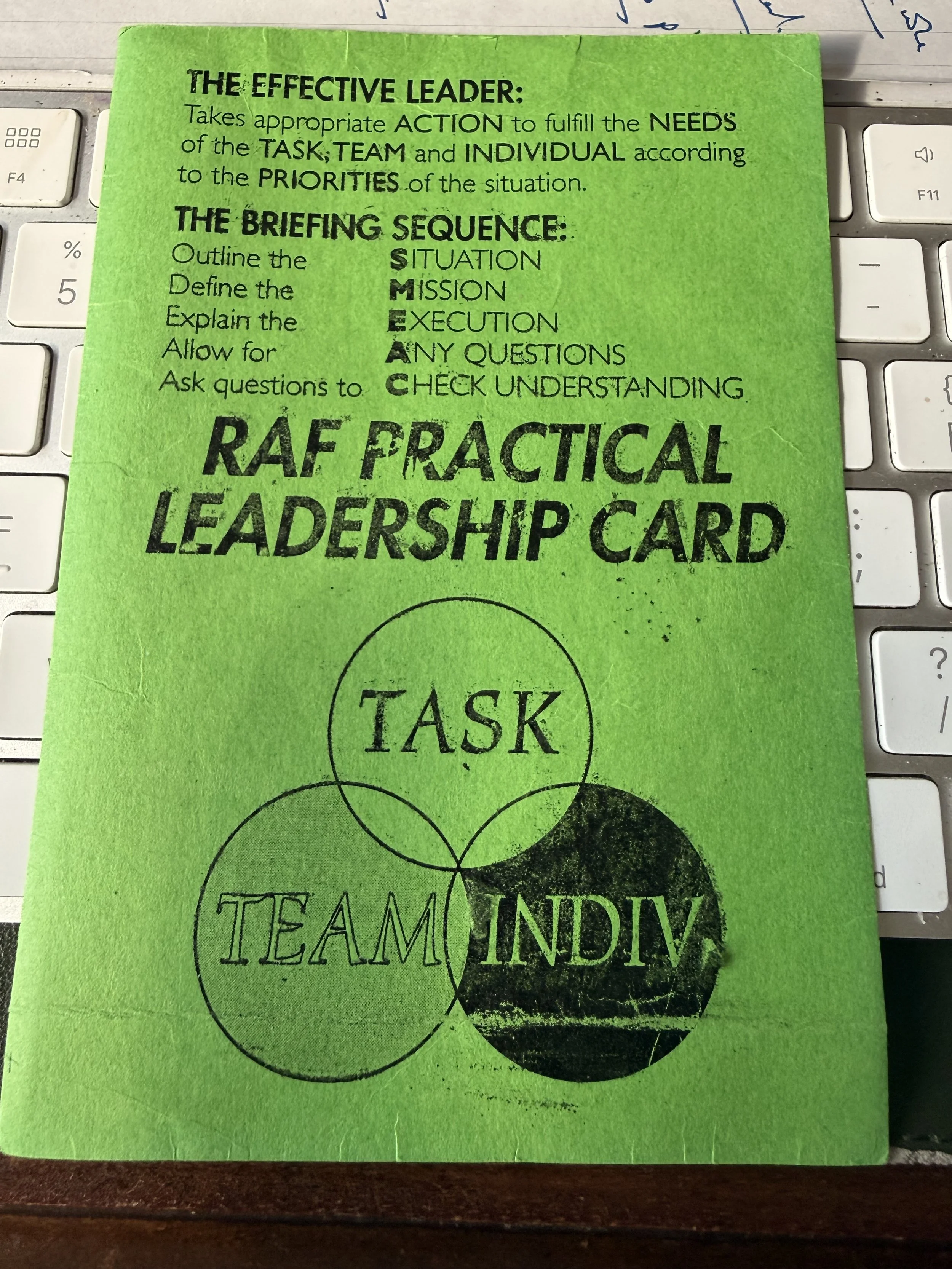
One practical leadership principle I learned through the Royal Air Force was simple: we never assume, we always check.
“Do you understand?” is rarely effective. Most people will say yes, either because they believe they understand or because they do not want to appear difficult.
A better question is:
“Just so I can check that I have explained this clearly, could you talk me through your understanding of what needs to happen?”
This is not a test. It allows both people to identify different interpretations before time, money and energy are wasted.
Balance the task, team and individual
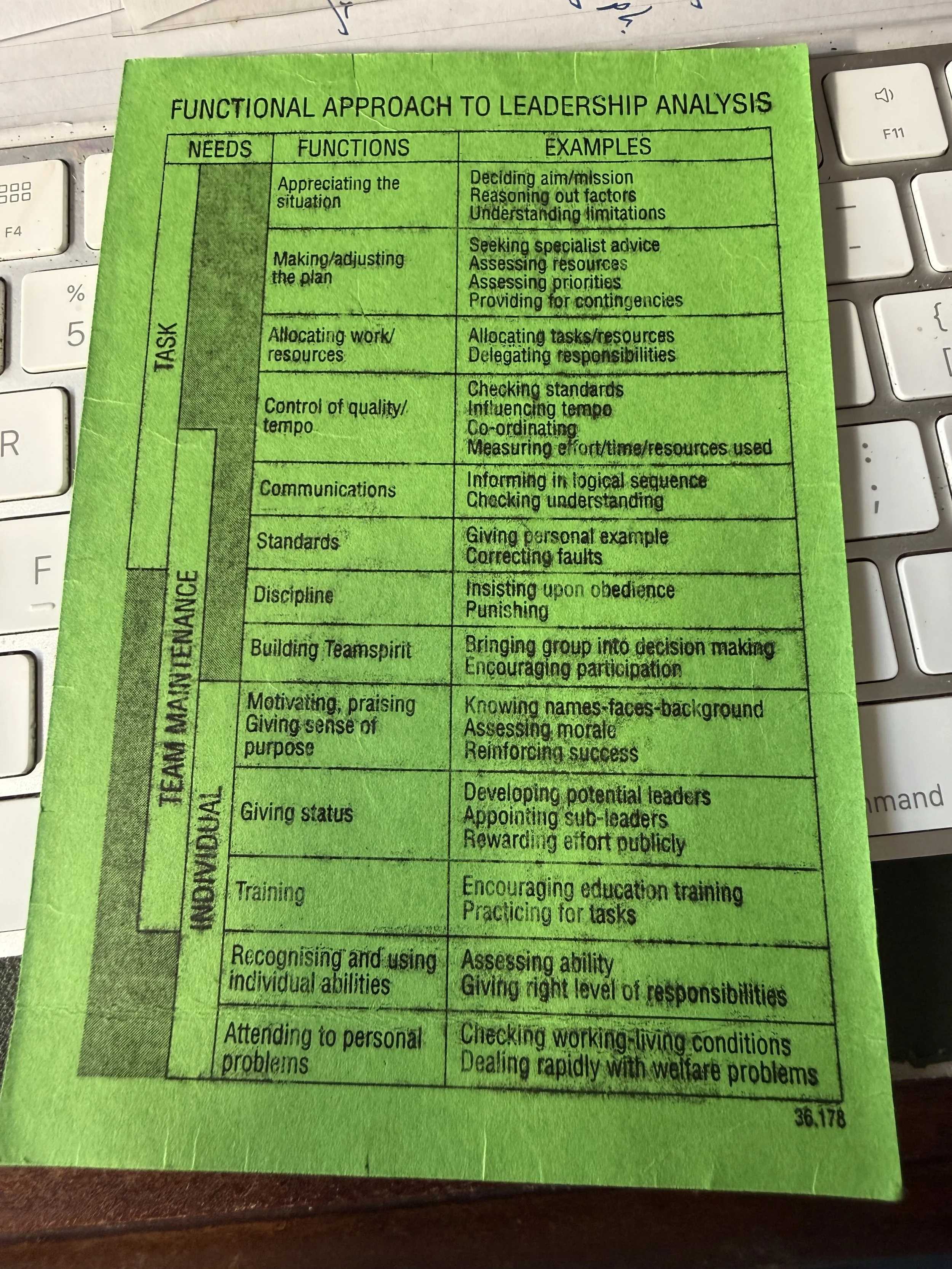
Professor John Adair’s Action-Centered Leadership model describes leadership as balancing three connected responsibilities: accomplishing the task, maintaining the team, and supporting the individual.
A result achieved while damaging trust, morale or capability may carry a long-term cost. Equally, supporting people without maintaining standards and accountability does not serve the individual, the team, or the organization.
Clarity is not micromanagement
Clear delegation establishes the outcome, authority and boundaries. It should then provide appropriate freedom within them.
The leader remains responsible for progress and standards, but should not hover over every decision. People perform best when they know what they own, how success will be judged, and when they should seek support.
If work comes back differently from what you expected, ask two questions:
“Did they misunderstand?”
“Did I explain it clearly enough?”
The second question is often where leadership begins.
Peter Gourri Coaching & Consulting LLC helps executives, lawyers, business owners, and leadership teams improve communication, delegation, accountability, and performance.
Learn more at www.petergourri.com
or arrange a conversation:
https://calendly.com/petergourri-coaching/success
If this article could help another leader or team, please share it.
Transparency statement: I have used AI as a drafting and editing tool to help formulate and prepare this article. The experiences, opinions, thoughts, and ideas are mine, and I take full responsibility for the final words and everything published under my name.
Adult Supervision Required - A New Podcast About AI, Leadership and Human Judgement
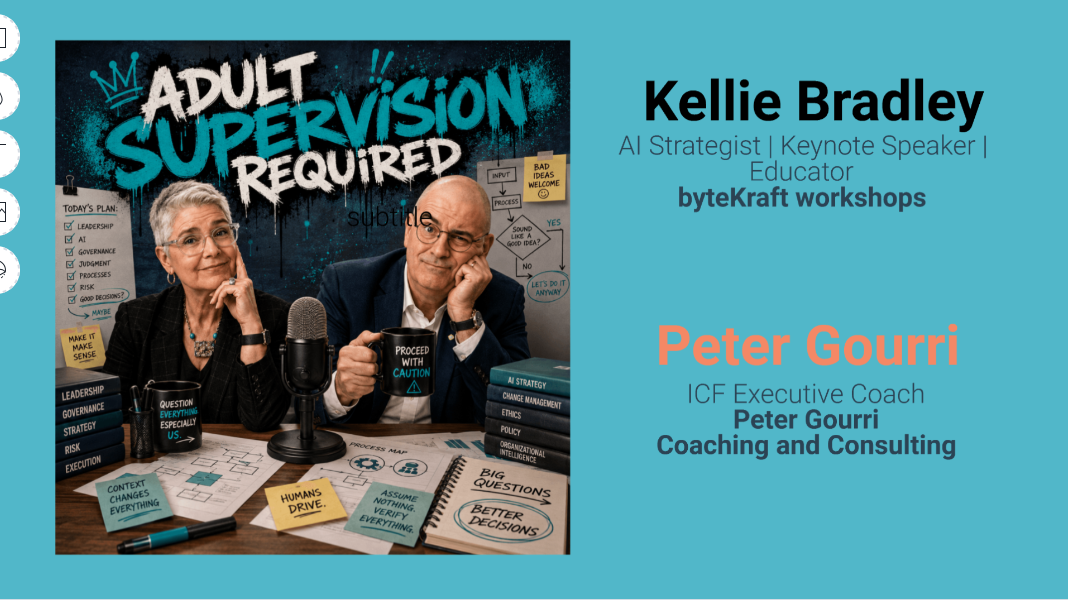
Peter Gourri and Kellie Bradley introduce Adult Supervision Required, a candid and good humoured new podcast exploring artificial intelligence, leadership, accountability, and what happens when technology meets the realities of business.
Adult Supervision Required has arrived
I am delighted to introduce Adult Supervision Required, a new podcast that I am presenting with my friend and fellow professional, Kellie Bradley.
Kellie is an AI strategist, keynote speaker, educator, and the founder of byteKraft workshops. She brings more than 40 years of experience in marketing and business development, together with a highly practical understanding of how artificial intelligence can support individuals and organizations.
I join her as a former lawyer, business leader, and now ICF Executive Coach and consultant.
Between us, we have spent many years working with organizations, business owners, senior leaders, and professionals. We have also encountered plenty of situations in which technology has been introduced without sufficient thought, decisions have been made without proper scrutiny, and responsibility has become rather difficult to locate when something has gone wrong.
That is where Adult Supervision Required begins.
Artificial intelligence offers businesses remarkable opportunities. It can improve efficiency, expand capability, support creativity, and help people approach familiar problems in new ways.
However, AI cannot accept responsibility. It cannot protect an organization’s reputation, understand its culture, or exercise the human judgment required when circumstances become complicated.
Those responsibilities remain firmly with us.
In each episode, Kellie and I will explore what happens when AI meets the realities of leadership, governance, accountability, communication, business, and human behavior.
The conversations will be candid, practical, occasionally irreverent, and hopefully useful.
Sometimes artificial intelligence requires adult supervision.
Sometimes it is not entirely clear whether the technology or the people using it require the most supervision.
Our first episode was recorded in advance. Future episodes will be broadcast live every two weeks, giving viewers the opportunity to join the conversation as it happens.
Our next live episodes will be broadcast on:
September 8, 2026, at 7:00 am ET
September 22, 2026, at 7:00 am ET
Kellie and I would be delighted to receive your feedback.
If you have a question about artificial intelligence, leadership, accountability, governance, business, or questionable judgment, please send it to us. We may feature your question in an upcoming episode.
Watch the first episode and subscribe free of charge:
You can also learn more about my executive coaching and consulting work at:

“God Is My CEO”: More Than a Business Slogan
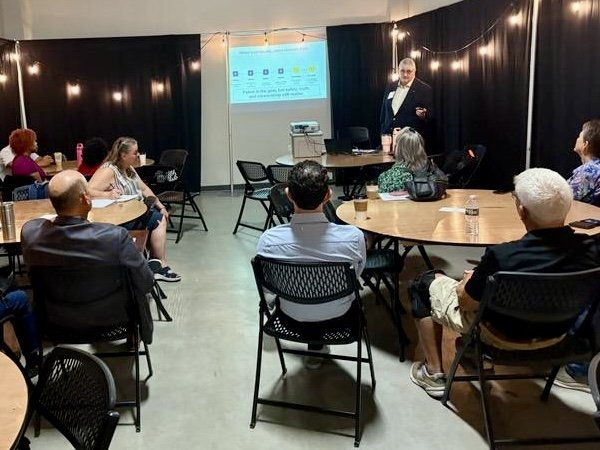
Today, I had the privilege of speaking at the Triangle Christian Chamber of Commerce’s Southern Wake and Harnett County gathering in Fuquay-Varina.
My presentation, “‘God Is My CEO’: More Than a Business Slogan,” considered a deceptively simple question.
Today, I had the privilege of speaking at the Triangle Christian Chamber of Commerce’s Southern Wake and Harnett County gathering in Fuquay-Varina.
My presentation, “‘God Is My CEO’: More Than a Business Slogan,” considered a deceptively simple question:
If we say God guides our businesses, what visible difference should that make in the way we lead, make decisions, respond to challenges and treat other people?
Faith Should Be Visible in Our Conduct
Christian identity should not be treated as a marketing advantage. A faith-based slogan, symbol or statement has little meaning unless it is reflected in the daily conduct of the business and its leaders.
The real test often comes when living by our values carries a cost.
Do we remain honest when an easier answer would be more profitable? Do we treat people with dignity when a relationship becomes difficult? Do we accept responsibility when we make a mistake? Are our prices, promises and expectations fair? Do we listen with humility, or do we assume that our position or experience makes us right?
These are not abstract theological questions. They arise every day in conversations with customers, employees, suppliers, competitors and colleagues.
Leadership Without the Pretense of Perfection
Faith-led leadership does not require us to present ourselves as perfect. None of us is.
It asks us to lead with integrity, to have the courage to do what is right when it costs us, to extend grace when relationships become difficult, and to remember that every person we encounter bears God’s image.
When our faith genuinely shapes our leadership, people should experience the difference—not because we continually announce it, but because of the way we conduct ourselves.
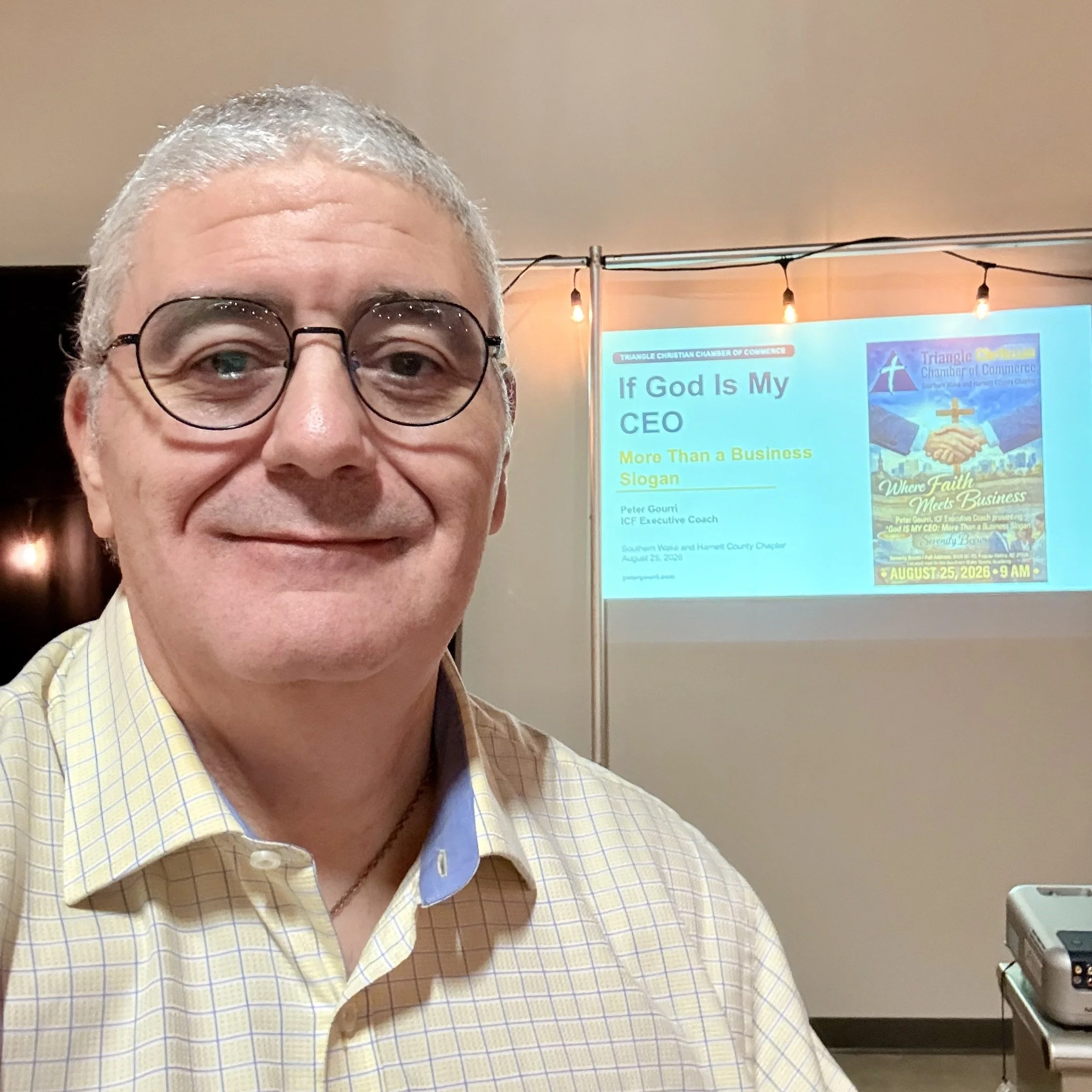
Thank You
My sincere thanks to Mark and Roxanne Sesti of MFS Home Inspection Services for inviting me to speak, and to everyone who attended and contributed so openly to the conversation.
I deliberately allowed additional time for discussion because this is not a subject that should end with the final presentation slide. I hope the session helped sustain interest in the Chamber, encouraged prospective members and prompted everyone present to reflect on how faith appears in the everyday realities of business.
I would be delighted to repeat this presentation—or deliver another leadership, career or professional-development talk—for businesses, churches, professional associations and community groups.
To discuss a future speaking engagement, please contact me through www.petergourri.com.

It Is Never Selfish to Put Yourself First
Generosity and service are admirable, but they should not require us to neglect our own wellbeing, undervalue our expertise or tolerate broken agreements.
At the weekend, I met two remarkable people. One was a lawyer; the other was a consultant.
Both were kind, intelligent, and accomplished professionals who genuinely believed in helping others. With their permission, our conversations moved into coaching.
Although their circumstances were different, the same theme emerged.
Both were prepared to help other people at their own expense. Both felt uncomfortable charging appropriately for the value they provided. Both appeared to equate putting themselves first with selfishness.
It is an association worth challenging.
Healthy self-interest is not selfishness
There is a profound difference between healthy self-interest and selfishness.
Healthy self-interest means recognizing that your time, energy, experience and expertise have value. It means understanding that you cannot continually support others while neglecting your own financial, emotional and physical wellbeing.
Selfishness is something different.
It is expecting other people to give their time, influence, contacts or expertise without considering the cost to them. It is treating relationships primarily as sources of personal advantage. It is asking repeatedly without pausing to consider whether support has ever traveled in the opposite direction.
When does support become one-sided?
This distinction came sharply into focus recently when I received several promotional emails.
One came from someone publishing a book, asking people to purchase it, promote it on LinkedIn and introduce it to their contacts. Another came from someone I have known since childhood, who had reactivated a sizeable mailing list and begun sending daily promotional messages.
There is nothing inherently wrong with focus, ambition, or asking for support. I have willingly helped friends with book launches because they are good friends and I wanted to see them succeed.
The question is not whether someone asks for help.
The question is whether the relationship has been reciprocal—or whether the traffic only begins moving when they need something from you.
That same question arises in professional relationships.
Many generous professionals provide support at substantially reduced rates, continue working while invoices remain outstanding, or allow agreed payment dates to pass without addressing them.
They may worry that asking to be paid will make them appear difficult, unsympathetic, or overly concerned with money. Perhaps they assume the other person is facing temporary difficulties. Perhaps they believe that patience and generosity are simply parts of being supportive.
But paying someone for valuable work is not a favor to them.
It is honoring an agreement.
Service above self does not mean service instead of self
Service above self is a noble principle. It does not mean service instead of self.
Generosity should be a conscious choice, not an obligation created by guilt. Kindness should not require us to put ourselves in financial insecurity. Supporting others does not mean giving them unrestricted access to our time, knowledge, or goodwill.
We also teach people how to treat us.
When we continually discount our value, tolerate late payment or provide expertise without boundaries, some people will interpret generosity as unlimited availability. Others may begin to regard what was freely given as something to which they are entitled.
What began as an act of kindness can gradually become an expectation.
What was intended as temporary support can become a permanent arrangement.
And what initially felt generous can eventually create frustration, resentment, and exhaustion.
Boundaries make kindness sustainable
Putting yourself first can mean charging appropriately.
It can mean asking to be paid on time.
It can mean declining another request for unpaid help.
It can mean questioning whether a relationship contains genuine mutuality or merely repeated demands upon your goodwill.
None of that makes you unkind.
It makes your kindness sustainable.
The answer is not to become hardened, transactional or unwilling to help. It is to become more discerning about where our generosity goes, why we are offering it and whether we can genuinely afford to give it.
Healthy boundaries do not prevent generosity. They allow generosity to remain freely chosen rather than becoming an obligation.
Questions worth asking yourself
When you find yourself repeatedly giving more than you receive, consider asking:
Am I helping because I freely choose to—or because I feel guilty saying no?
Does this relationship contain mutual care, or merely mutual familiarity?
Has support traveled in both directions?
Would I advise someone I cared about to accept the same arrangement?
Am I supporting another person’s success while quietly undermining my own?
Can I genuinely afford to continue giving my time, expertise or money in this way?
The answers may not always be comfortable, but they can be revealing.
You matter too
You can be generous without being exploited.
You can serve others without abandoning yourself.
You can be kind, principled and compassionate while still expecting your work to be valued and your agreements to be honored.
Putting yourself first does not mean that nobody else matters.
It means recognizing that you matter too.
If you are reconsidering your professional boundaries, struggling to recognize your own value, or finding it difficult to balance generosity with your own needs, coaching can provide the confidential space and clarity needed to decide what should change.

Ten Years of Reinvention: Leadership Forged Under Pressure
Ten Years of Reinvention: Leadership Forged Under Pressure
Executive coaching for lawyers, executives, and business owners often begins at a moment of disruption.
January 14, 2026 marks ten years since I arrived in the United States to live, a decade that reshaped my leadership, identity, and professional purpose.
Ten Years of Reinvention: Leadership Forged Under Pressure
Executive coaching for lawyers, executives, and business owners often begins at a moment of disruption.
January 14, 2026 marks ten years since I arrived in the United States to live, a decade that reshaped my leadership, identity, and professional purpose.
Like many senior professionals relocating internationally, I arrived with experience, ambition, and optimism. What followed was not a smooth ascent, but a prolonged period of challenge that demanded resilience, adaptability, and deep self-honesty.
During that decade, I lost my mother. My marriage ended abruptly. I suffered betrayal, I survived severe Covid with a long recovery. I was seriously injured in a car accident, resulting in permanent injury and chronic pain. Professionally, I exited a narcissistic working environment in Manhattan, changed careers entirely, and relocated from New York and New Jersey to North Carolina.
At several points, survival, not success, was the objective.
To adapt, I had to improvise.
To move forward, I had to evolve.
I lost over 150 pounds. I released identities, roles, and environments that no longer served me. Chronic pain remains part of my daily reality, limiting aspects of the life I would love to live but it also sharpened my clarity, emotional intelligence, and judgment.
What emerged was not bitterness, but perspective.
Today, through Peter Gourri Coaching & Consulting, I work with lawyers, executives, and business owners navigating transition, pressure, burnout, or identity shifts. Many are highly accomplished on paper yet privately exhausted, misaligned, or uncertain about what comes next.
Leadership is not defined by comfort.
It is revealed under pressure.
My coaching approach is grounded, discreet, and practical. This is not motivational theatre. It is a confidential space for reflection, recalibration, and decisive action — informed by lived experience rather than theory alone.
At 55¾, I am optimistic, grounded, and genuinely excited about the future. The past decade tested every assumption I held about success. It also equipped me to help others lead with clarity and calm authority.
If this article resonates, please consider sharing it — it may help someone quietly navigating change.
Learn more at www.petergourri.com
Or book a confidential conversation here:
👉 https://calendly.com/petergourri-coaching/success

Why Ethical Coaching and Professional Standards Matter More Than Ever
Why Ethical Coaching, Proper Training, and Professional Standards Matter More Than Ever
It was drawn to my attention recently that there has been coverage in the British media and that the BBC produced a documentary concerning a coaching organization that was formerly based in the United Kingdom and has been the subject of public scrutiny.
Why Ethical Coaching, Proper Training, and Professional Standards Matter More Than Ever
It was drawn to my attention recently that there has been coverage in the British media and that the BBC produced a documentary concerning a coaching organisation that was formerly based in the United Kingdom and has been the subject of public scrutiny.
The public record shows that the organisation’s UK business entity was placed into insolvency and wound up by the government in the public interest following an investigation. That step is relatively unusual and understandably causes people to pause and ask questions. I make no comment whatsoever on that case, the facts, the individuals involved, or the underlying allegations. That would be inappropriate.
What I have noticed is that the organisation appears to retain an online presence outside the UK. Again, I offer no comment on what that may or may not mean.
What this situation does raise, however — and this is the important point — is the broader issue of unethical or poorly practised coaching. It highlights the reality that some individuals operate as coaches without training, without professional supervision, and without any recognised ethical framework. In some cases, this is opportunism. In others, it is simply a lack of competence or understanding of professional boundaries.
Coaching, as an industry, is not uniformly regulated. That places a responsibility on both practitioners and clients to exercise discernment. Choosing a coach who has received proper training and who abides by a recognised code of ethics is not about elitism or gatekeeping. It is about client protection, integrity, and trust.
This is where professional bodies such as the International Coaching Federation (ICF) play a crucial role.
ICF-aligned coaching is grounded in a clearly articulated Code of Ethics and a globally recognised set of Core Coaching Competencies. These standards exist to protect clients and to ensure that coaching is conducted with professionalism, transparency, confidentiality, and respect for client autonomy.
Becoming an ICF-credentialed coach is not a marketing exercise or a weekend certification. It is a rigorous process. It involves completing accredited coach training, logging substantial verified coaching hours, undertaking mentor coaching with qualified supervisors, and being formally assessed against professional standards. Credentialed coaches are also required to commit to ongoing professional development and ethical accountability.
These safeguards matter. They define what coaching is and what it is not. Ethical coaching is not therapy. It is not persuasion. It is not ideology. And it is certainly not about control or dependency. Ethical coaching is a structured partnership that supports independent thinking, better judgment, and intentional action.
It is important to be fair and balanced here.
Formal training alone does not automatically make someone an excellent coach, and the absence of formal training does not automatically mean someone is a poor one. There are highly effective coaches who have never undertaken formal training, just as there are trained coaches who are less effective in practice.
However, ethical coaching must always be the priority.
For me personally, this is precisely why I chose to train formally. I took a year out, invested significant time, and spent in excess of $30,000 to become a highly trained, ethical executive coach. That decision was not accidental. It likely stems from my professional background as a lawyer, where doing things properly, respecting boundaries, and adhering to standards are not optional — they are fundamental.
That mindset carries directly into my coaching practice.
Ethical coaching means clarity of role. It means confidentiality. It means professional boundaries. It means transparency around fees and scope. It means knowing when coaching is appropriate — and when it is not — and being willing to refer a client elsewhere if their needs fall outside the coaching relationship.
What it does not mean is influence, pressure, dependency, or persuasion.
Finally, it is worth stating this clearly: a small number of poor or high-profile examples do not define an entire profession. It would be incorrect and unfair to conclude that all coaches are unethical, con artists, or cult-like simply because of a handful of cases. That is not the reality I see in professional coaching.
Most ethical, professional coaches are thoughtful, well-trained, and genuinely committed to supporting others in ways that strengthen independence rather than undermine it.
If you are considering working with a coach, I encourage you to ask questions. Ask about training. Ask about ethics. Ask about supervision, boundaries, and accountability. A professional coach will welcome those questions — not resist them.
You can learn more about my approach to ethical executive coaching and the services I offer to lawyers, executives, and business owners in the US and UK at www.petergourri.com.
And if this article helps bring balance, clarity, or reassurance to the conversation, please feel free to share it — it may help others choose wisely.

Career Optionality: How to Build a Runway for Your Next Move
This Week’s Micro-Action (5–15 minutes)
Capture your safety, signal, and skill plan on one page. Share it with a trusted ally who will hold you kindly accountable.

It’s Never Too Late to Plan for 2026 and Beyond (Part 9)
This week continues our gentle, practical Wednesday series—created to help you build a thriving future for your career and business, one kind and consistent step at a time.
It’s never too late to plan your next season. Whether you’re relaunching after a setback, scaling what already works, or quietly pivoting toward something truer, progress doesn’t have to come from pressure. Over the coming Wednesdays, I’ll guide you through a calm, proven planning rhythm: clarify what you want, choose fewer priorities, and take small steps that compound. This series blends reflection with action, so you always know what to think about—and what to do next.
If you’d like personal support at any point, you can book a complimentary planning session here:
https://calendly.com/petergourri-coaching/success
Career Optionality: Build Your Runway
Big career moves feel safer when you’ve built options. Optionality isn’t about rushing toward change—it’s about creating enough space that choice becomes available. This week, we focus on building a runway by strengthening three foundations: safety, signal, and skill.
This Week’s Practice
Safety: Identify a target financial buffer of three to six months of expenses. Then outline a steady, realistic plan to grow it over time.
Signal: Publish one small piece each week that shows how you think—an insight, reflection, or lesson learned. In parallel, book five warm conversations this month with people already in your orbit.
Skill: Choose one capability that will matter most in the coming months. Decide how you’ll sharpen it by March through a course, mentor, or consistent practice cadence.
These three moves work quietly in the background, increasing confidence and reducing risk.
This Week’s Micro-Action (5–15 minutes)
Capture your safety, signal, and skill plan on one page. Share it with a trusted ally who will hold you kindly accountable.
Optionality doesn’t demand urgency. It rewards preparation.

How to Plan Gently Through the Holidays Without Losing Momentum
Learn a light, restorative way to plan through the holidays. Use simple reflection and gentle structure to prepare for January without burnout.

It’s Never Too Late to Plan for 2026 and Beyond (Part 8)
This week continues our gentle, practical Wednesday series—created to help you build a thriving future for your career and business, one kind and consistent step at a time.
It’s never too late to plan your next season. Whether you’re relaunching after a setback, scaling what already works, or quietly pivoting toward something truer, progress doesn’t have to come from pressure. Over the coming Wednesdays, I’ll guide you through a calm, proven planning rhythm: clarify what you want, choose fewer priorities, and take small steps that compound. This series blends reflection with action, so you always know what to think about—and what to do next.
If you’d like personal support at any point, you can book a complimentary planning session here:
https://calendly.com/petergourri-coaching/success
Planning Through the Holidays (Light Touch)
Grace over grind. The final days of the year are not a sprint—they’re a season to restore, reflect, and plant a few quiet seeds for January. This week, we keep the cadence intentionally gentle so you can be present with the people, rest, and moments that matter most.
This Week’s Practice
Schedule three one-hour sessions this week, each with a light touch:
A January idea dump—no editing, just capture what’s on your mind
A quick systems tidy—email, files, finances, or calendars
Messages of appreciation to three people who supported you this year
These small acts create clarity, closure, and readiness without depletion.
This Week’s Micro-Action (5–15 minutes)
Choose the smallest, kindest version of each hour. Light touches still count—and they add up.
If you’d like to start January with clarity and momentum, you can book a January kick-off session now while diaries are quiet:
https://calendly.com/petergourri-coaching/success
Rest is not a pause from progress. It’s part of how progress becomes sustainable.

The Quiet Magic of Gratitude (Sunday Thoughts)
The Quiet Magic of Gratitude (Sunday Thoughts)
There’s an old Grimm story, which was a favorite of mine as a child, The Elves and the Shoemaker, that still has a lot to say to modern leaders.
The Quiet Magic of Gratitude (Sunday Thoughts)
There’s an old Grimm story, which was a favorite of mine as a child, The Elves and the Shoemaker, that still has a lot to say to modern leaders.
A shoemaker is honest and skilled, but he’s reached the point so many professionals dread: he has almost nothing left. One final piece of leather. One last chance to keep the work going. He cuts it carefully, determined to finish the shoes the next morning.
Overnight, someone finishes them for him, beautifully.
He sells the shoes. He buys more leather. It happens again. Gradually, his situation changes, not through a dramatic “overnight success” story, but through repeated small wins that rebuild confidence, reputation, and income.
But the part that warms my heart isn’t the mystery help. It’s the response.
When the shoemaker finally discovers who helped, he doesn’t turn it into a transaction. He doesn’t cling. He doesn’t demand more. He offers gratitude that has substance: warm clothes and sturdy little shoes made with care.
If you’re leading a team, running a firm, or building a business, this tale offers three practical reminders:
Keep the standard high when resources are low
What you do in the tight season becomes your reputation in the growth season.
Notice the “invisible contributors.”
Progress is rarely a solo act. It’s often the quiet chain of people who catch errors, hold the line, create space, and steady you when you wobble.
Make gratitude practical
A meaningful thank-you isn’t just a compliment. It can be clarity, protection, flexibility, recognition, better systems, fair pay, or simply time and attention.
This week, consider one question:
Who is quietly making your work possible right now, and what would a practical “thank you” look like?
If this resonates, please share it with someone who might need the reminder.
More leadership reflections and executive coaching support (US + UK) at www.petergourri.com. If you’d like to meet, you can book a conversation here: https://calendly.com/petergourri-coaching/success
#pgcc #website #socialmedia #leadership

A Simple 30–90 Day Planning Method to Build Momentum
Turn your next milestone into steady, achievable progress. Learn how to create a simple 30–90 day action plan that builds consistency and lasting momentum.

It’s Never Too Late to Plan for 2026 and Beyond (Part 6)
It’s Never Too Late to Plan for 2026 and Beyond
Wednesday Planning Series — Dec 10, 2025
This week continues our gentle, practical Wednesday series—created to help you build a thriving future for your career and business, one kind and consistent step at a time.
It’s never too late to plan your next season. Whether you’re relaunching after a setback, scaling what already works, or quietly pivoting toward something truer, the path forward becomes lighter when you move with clarity and consistency. Over the coming Wednesdays, I’ll guide you through a calm, proven planning rhythm: clarify what you want, choose fewer priorities, and take small steps that compound. This series blends reflection with action, so you always know what to think about—and what to do next.
If you’d like personal support at any point, explore the resources at www.petergourri.com or book a complimentary planning session here: https://calendly.com/petergourri-coaching/success
First 30–90 Days: Keep It Simple
Consistency beats intensity. Once you’ve defined your first milestone, the next step is to translate it into small, finishable actions. We aren’t optimizing for theatrics—we’re optimizing for traction. Simple, steady movement wins.
This Week’s Practice
Break Milestone 1 into 3–7 actions you can complete in the next 30–90 days. Assign dates and owners, even if the owner is you. Keep every action small enough to move forward in a single focused block of time. Review your progress once a week so you can stay on track and refine as you go.
This Week’s Micro-Action (5–15 minutes)
When in doubt, shrink the action until it feels almost embarrassingly doable—then do it. Small movement compounds faster than big, inconsistent effort.
If you’d like a simple planning sheet to outline your 30–90 day actions, visit www.petergourri.com.
Your next chapter is built in small, steady steps. Let’s take them together.

The Legal Profession Has Evolved for Over 1,000 Years, And It Will Continue to Evolve
The Legal Profession Has Evolved for Over 1,000 Years. And It Will Continue to Evolve
The recent City A.M. report on Clifford Chance’s AI-driven restructuring has stirred understandable anxiety:
https://www.cityam.com/clifford-chance-ai-driven-redundancies-hit-london-business-service-roles/
The recent City A.M. report on Clifford Chance’s AI-driven restructuring has stirred understandable anxiety:
https://www.cityam.com/clifford-chance-ai-driven-redundancies-hit-london-business-service-roles/
Job losses are deeply difficult at any time, but when they happen before the holidays, their emotional toll is greater. They impact confidence, stability, and the outlook on what’s next.
But this moment is not the end. Not for the individuals affected or for the profession itself.
For more than a thousand years, the legal world has been shaped by continuous evolution. And at every major turning point, people predicted its collapse.
When the internet arrived, many believed we were finished.
When Google placed the world’s information at our fingertips, people said research and legal analysis were no longer needed.
When digital systems replaced paper, many said the profession couldn’t survive the shift.
It survived.
It adapted.
It grew.
AI is simply the next phase of that long arc.
Yes, some roles will change. Some tasks may disappear. But AI cannot replace the essence of legal work: judgment, empathy, communication, leadership, and strategic thinking.
I’ve lived personal reinvention. At age 48, after decades in law, I changed careers, and it became one of the most meaningful steps I ever took. Reinvention is real, at any age.
The future is not something that happens to us; it is something we shape.
And with resilience, clarity, and the right support, all will be well.
If this may help someone today, please share it.
More insights at www.petergourri.com.

Sunday Thoughts: Leadership Through the Shepherd’s Eyes
Long before there were corporate structures or leadership theories, the shepherd stood as one of humanity’s earliest models of leadership. And even with all our progress, the metaphor remains remarkably relevant.
Imagine a flock gathered at dusk inside a pen. One entrance. Clear boundaries. A protected space that keeps danger out and gives the flock a sense of security. It’s the earliest version of what we now call psychological safety.
Long before there were corporate structures or leadership theories, the shepherd stood as one of humanity’s earliest models of leadership. And even with all our progress, the metaphor remains remarkably relevant.
Imagine a flock gathered at dusk inside a pen. One entrance. Clear boundaries. A protected space that keeps danger out and gives the flock a sense of security. It’s the earliest version of what we now call psychological safety.
Then imagine the shepherd, calm, steady, and quietly present. He doesn’t dominate or intimidate. He leads through familiarity, consistency, and trust. Even when several flocks mingle, each flock responds only to its own shepherd’s voice, recognising the one who has guided and protected them.
This ancient scene reflects modern leadership more than most people realise.
In today’s organisations, people face countless “voices and forces” that climb over the walls, including stress, ego, fear, burnout, organisational politics, and cultural noise. These influences bypass trust and often create confusion or instability.
But genuine leadership looks a lot like the shepherd.
It is:
• Steady
• Trusted
• Consistent
• Clear
• Present
• Grounded
Leaders who adopt this approach create environments where people can think clearly, grow confidently, and contribute fully.
In coaching sessions across the UK and USA, I repeatedly see that leaders and professionals have an internal compass, a quieter voice, that already knows their direction. It’s simply drowned out by the noise of modern corporate life.
When they reconnect with that voice, they lead differently. Teams respond differently. Performance improves organically.
As you move into the week, consider this:
Follow the voice that brings clarity, not chaos.
Lead like the shepherd, with steadiness, presence, and trust.
And build environments where people feel safe enough to do their best work.
More reflections and resources at www.petergourri.com.

Small Business Saturday: Why Your Support Matters More Than Ever
Small Business Saturday is a unique moment each year, a day dedicated not to sales or offers, but to recognizing the importance of independent businesses and the people behind them.
While many of us spend this weekend clearing out inboxes full of Black Friday promotions, today offers a quieter, more meaningful opportunity. It invites us to reflect on the individuals, families, and local entrepreneurs who pour their expertise, creativity, and heart into building something that serves others.
Small Business Saturday is a unique moment each year, a day dedicated not to sales or offers, but to recognizing the importance of independent businesses and the people behind them.
While many of us spend this weekend clearing out inboxes full of Black Friday promotions, today offers a quieter, more meaningful opportunity. It invites us to reflect on the individuals, families, and local entrepreneurs who pour their expertise, creativity, and heart into building something that serves others.
Since transitioning from a long legal career into coaching and consulting, I’ve experienced firsthand the challenges and extraordinary rewards of running a small business. Supporting lawyers, executives, business owners, and individuals has given me a unique window into the impact that small enterprises can create when they lead with integrity and personalized care. Only today, I received a message out of the blue from an individual I coached, saying, “Peter, how are you? I hope all is well. Thought I’d share some news with you: my company bumped me up a level in the function I was in. I am very pleased about it and often reflect on our conversations to help me navigate the complicated landscape in the office.”
Small businesses aren’t faceless.
We’re relational.
We’re intentional.
We’re deeply invested in our clients' success.
At www.petergourri.com, every client conversation matters. Every moment of clarity or breakthrough is meaningful. And every referral or recommendation is appreciated far more than most people realize.
On this Small Business Saturday, I want to celebrate all the independent professionals who continue to serve their communities with dedication and resilience. And I want to gently ask: if you’ve benefited from my work or know someone who might, please consider sharing my name, website, or posts today.
Your support keeps small businesses strong. Your belief helps us continue making an impact.
Thank you for supporting small businesses and for being part of this journey.

Grateful for the work, but more so for the people
Grateful for the work but more so for the people!
As we approach Thanksgiving, it feels like the right time to pause and reflect on the people and organizations I’ve had the privilege of working with over the past few years.
Since stepping out of full-time legal practice, my coaching and consulting work has grown in ways I could not have predicted. Since 2018, I’ve delivered well over 1000 one-to-one coaching sessions with leaders across North America, the UK, Europe, and as far away as Singapore and Australia.
Grateful for the work but more so for the people!
As we approach Thanksgiving, it feels like the right time to pause and reflect on the people and organizations I’ve had the privilege of working with over the past few years.
Since stepping out of full-time legal practice, my coaching and consulting work has grown in ways I could not have predicted. Since 2018, I’ve delivered well over 1000 one-to-one coaching sessions with leaders across North America, the UK, Europe, and as far away as Australia.
In the last year alone, I’ve worked with:
US, UK, and Canadian attorneys, solicitors, legal executives, and barristers
In-house counsel in major corporations and financial institutions
Members of the British Civil Service and other public sector leaders
Veterans in industry, building second careers and bringing service-led leadership into new sectors
COOs and senior leaders in construction and related industries
Owners and leaders of small businesses
Leaders in the finance industry, including banking, insurance, and investment
Healthcare providers and life sciences leaders
Alongside leaders in media, marketing and communications, automotive and mobility, technology and digital platforms, retail and e-commerce, energy and climate, aviation and security, arts, culture, and non-profit.
Behind each of these labels are real people with real pressures. People are trying to balance responsibility with their own well-being. People navigating promotion, restructuring, complex risk, team dynamics, and personal change.
What I’m particularly grateful for is the trust my clients place in me when they bring the real issues into the coaching room:
The promotion they’re aiming for, but aren’t sure how to secure.
The restructuring they’re leading, and the impact it will have on people.
The quiet signs of burnout they can’t ignore any longer.
The difficult conversations they’ve delayed but know they need to have.
Those moments are where the real work happens. They are also where coaching earns its keep.
As I look ahead, my focus remains clear: to support senior leaders and their teams through growth, change, and uncertainty; to strengthen leadership benches, not just individual stars; and to create the kind of thinking space that allows for better, more grounded decisions.
If you’d like to explore how coaching or consulting might support you or your organization in the year ahead, you’re very welcome to get in touch.
You can find more about my work at www.petergourri.com or book a conversation directly via Calendly.

Focus on What Matters Most as You Plan for 2026 and Beyond
It’s never too late to plan your future—whether you’re relaunching after a setback, scaling what already works, or quietly pivoting toward something more authentic.
As many people reach the end of a busy year or step into a new one, a common feeling emerges: I know I want things to be better…but I’m not sure what “better” actually looks like.

It’s Never Too Late to Plan for 2026 and Beyond (Part 3)
Welcome to another part of our gentle, practical Wednesday series — a space created to help you build a thriving future in your career and business, one kind and consistent step at a time.
This series is for you whether you’re relaunching after a setback, scaling what already works, or quietly pivoting toward something truer. Over the coming Wednesdays, we’ll walk through a proven planning rhythm:
clarify what you want, choose fewer priorities, and take small steps that compound.
Each week blends reflection with action, so you always know what to think about — and what to do next.
If you’d like personalized support at any point, you can explore the resources at www.petergourri.com or book a complimentary planning session here: https://calendly.com/petergourri-coaching/success
Choose Your Big Four
Overwhelm isn’t a personal failing; it’s simply a mismatch between your capacity and your commitments. When too many projects compete for your attention, everything feels urgent — and nothing meaningfully moves.
Focus is a kindness.
By intentionally limiting your active projects, you increase the likelihood that any of them will truly be completed and yield the results you want.
Try This Gentle Planning Practice
Step 1: List every project tugging at your attention.
Don’t censor yourself; capture everything currently occupying your mind.
Step 2: Circle no more than four projects for the next 90 days.
These become your Big Four — the projects you’ll actively move forward.
Step 3: Move everything else to a “later” list.
You won’t lose them; you’ll simply review them monthly to see what’s still relevant.
Step 4: Give each active project a clear name and concise promise.
This ensures you know exactly what “done” looks like.
Example:
Project Name: Refresh Client Onboarding
Project Promise: Clients understand next steps within 10 minutes of signing.
Naming the promise helps you stay anchored in outcomes, not just tasks.
This Week’s Micro-Action (5–15 Minutes)
Block a weekly 20-minute review session to protect your Big Four from scope creep.
This single habit will keep your priorities stable and your progress steady, even on busy weeks.
Set the appointment. Honor it. Adjust gently as needed — the consistency matters more than the duration.
Want a One-Page Project Design Sheet?
If you’d like a simple template to structure each of your Big Four projects, you can download a one-page Project Design sheet at www.petergourri.com.
Your future is built one clear choice, one aligned priority, and one small weekly action at a time. You’re not behind. You’re right on time.